
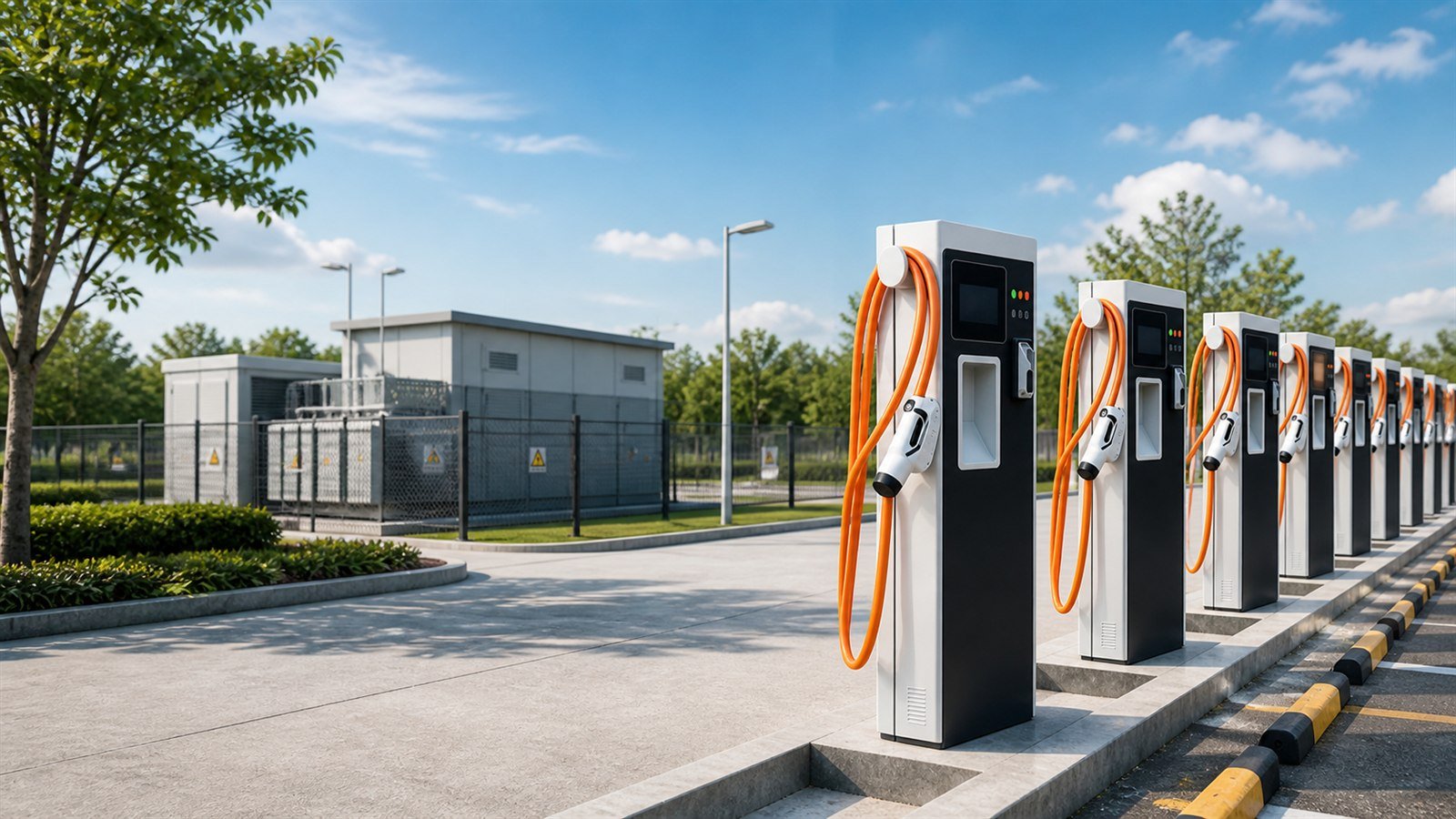
Start with the Charger Load
List the rated output of every AC and DC charger. DC fast chargers often dominate the load, but auxiliary systems—including lighting, ventilation, payment equipment, security and building services—must also be included.A Practical Capacity Estimate
A preliminary transformer rating can be estimated from total charger output, simultaneity, conversion efficiency, power factor, auxiliary demand and a design margin: Transformer kVA ≈ (Total charger kW × simultaneity ÷ efficiency ÷ power factor) + auxiliary load + expansion margin The result should be checked against the actual charger input data and local utility requirements. Not every charger operates at full power simultaneously, but highway hubs and fleet depots may have a higher coincidence factor than workplace or residential sites.Key Technical Issues
Harmonics
Power-electronic chargers generate harmonic current. Obtain harmonic data from the charger manufacturer and evaluate transformer heating, neutral current, cable sizing and power-quality mitigation.Load Growth
Plan for additional chargers and higher charging power. This may mean selecting a larger transformer, reserving space for a second unit or designing modular low-voltage distribution.Voltage Drop and Short-Circuit Level
Coordinate transformer impedance, cable length and conductor size so chargers receive acceptable voltage during peak demand while downstream equipment remains properly protected.Transformer Type
Oil-immersed transformers are economical for many outdoor stations. Dry-type transformers are suitable for indoor or fire-sensitive locations. A compact box-type substation can integrate medium-voltage, transformer and low-voltage equipment for faster project delivery.Applications
- Highway fast-charging stations
- Commercial parking and shopping centers
- Bus, logistics and fleet depots
- Residential and workplace charging
- Charging-station expansion projects
